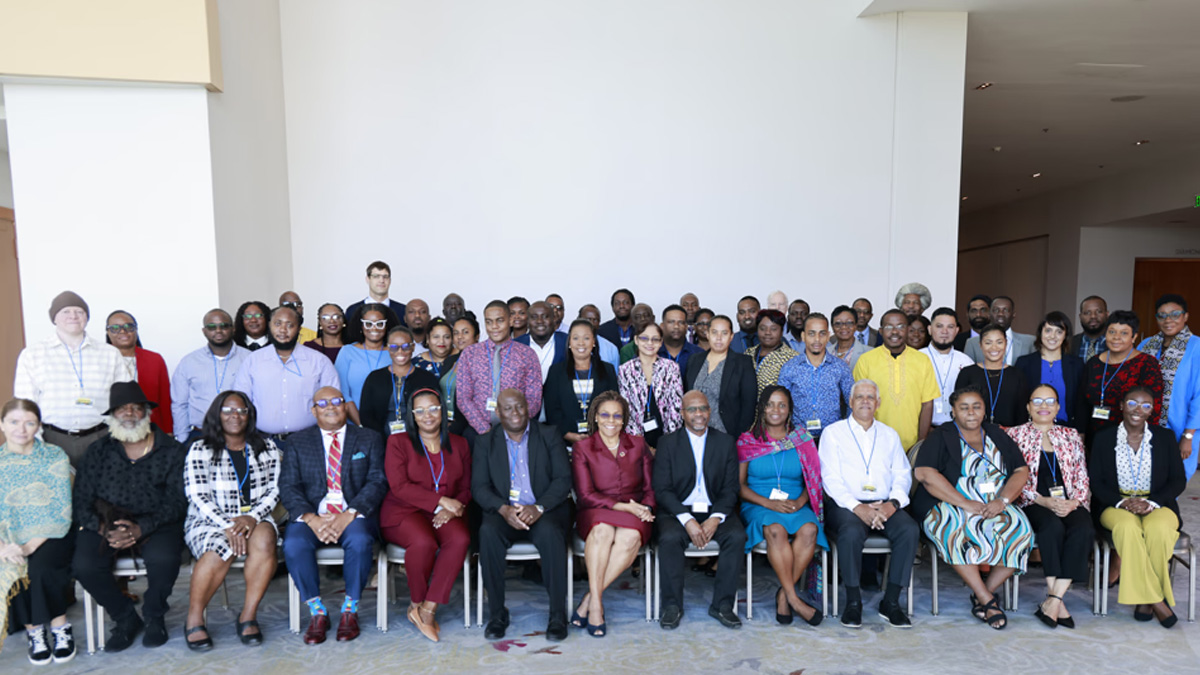
The fight against poverty is being accelerated in 2024. Poverty reduction in the context of sustainable development remains high on the agenda for the Organisation of Eastern Caribbean States (OECS) Commission, in pursuit of the achievement of Sustainable Development Goal 1- The Eradication of Poverty in all its Manifestations. Following requests made from Member States as well as the aftershocks of the COVID-19 pandemic which posed health challenges, negatively impacted learning, caused job loss and exacerbated economic and social ills, the OECS Commission in partnership with the Caribbean Development Bank and the World Bank-funded Data for Decision Making Project re-launched the Enhanced Country Poverty Assessment Programme and Data Anonymisation Workshop on Monday, January 15, 2024, in Port-of-Spain, Trinidad and Tobago. The re-launch opening ceremony and capacity-building workshop event (which ends on January 18, 2024) was conducted via a hybrid modality of in-person as well as live stream for virtual attendees and was attended by Permanent Secretaries, Statisticians, Economists, Policy Analysts, Social Analysts, and Community Development Specialists from across the Caribbean region. Technical specialists from the Caribbean Development Bank (CDB), The World Bank, The UN World Food Programme (WFP), The Economic Commission for Latin America and the Caribbean (ECLAC), and the OECS Commission also participated.
The updated Enhanced Country Poverty Assessment Programme (eCPA) will accelerate poverty reduction and promote economic stability through the alignment of data with policy direction in the OECS Member States keeping with the provisions of the Revised Treaty of Basseterre in creating an economic union that would facilitate social cohesion, economic development and build resilience.
“This project represents a commitment to understanding and addressing the multifaceted nature of poverty in our region,”
said the Director General of the OECS, Dr. Didacus Jules, as he delivered remarks at the opening ceremony. He further added:
“Utilizing cutting-edge technology and data analysis, we aim to gain a deeper, more nuanced understanding of the poverty landscape. This is not just about numbers and statistics; it’s about the real stories, struggles, and strengths of our people. This work should also assist the region in responding and measuring our progress, our gaps and challenges as we seek to meet the sustainable development goals (SDGs) specifically SDG 1 – ‘Eradication of Poverty in all its Manifestations’.”
Referencing CDB’s 2017 publication:
The Changing Nature of Poverty and Inequality in the Caribbean, New Issues, New Solutions, CDB Director of Projects, Mrs. Therese Turner-Jones, highlighted that the pandemic had exacerbated regional poverty in her remarks at the opening ceremony.
“COVID-19 created a sense of normlessness, worsened existing structural inequalities, compounded impediments to citizens’ participation in socio-economic activities across client countries. The confluence of these factors has hastened the need for client countries to be supported by CDB and other partners in undertaking poverty assessments to access current empirical data to inform development policy and planning,”
Mrs. Turner-Jones said, emphasising that the individual data collected would be kept strictly private.
Also delivering remarks [in order of appearance in the Programme] at the launch were Ms. Marie Hinds, Permanent Secretary (Ag.) Ministry of Planning and Development, Trinidad and Tobago, and Dr. Martin Baptiste, Division Chief, Social Sector Division, CDB.
Additionally, Mr. Olivier Dupriez, Deputy Chief Statistician, World Bank and Mr. Thijs Benschop, Statistician, World Bank, facilitated the Data Anonymisation Workshop which focused on Statistical Disclosure Control (SDC),
a technique used in statistics to assess and lower the risk of a person or organisation being re-identified from the results of an analysis of survey or administrative data, or in the release of microdata. A key highlight on Day 1 of the workshop was the practical training participants received through a hands-on-session in Software Installation and Exploration, the installation of the R package sdcMicro, exploration of the Graphical User Interface, as well as perturbative and non-perturbative data anonymisation methods (i.e. ways to respect confidentially, and make the data anonymous without compromising or changing the data).
The Enhanced Country Poverty Assessment was first launched in 2016 to measure the multi-dimensional aspects of poverty and living conditions. It consisted of five components: the Survey of Living Conditions/ Household Budgetary Survey, the Institutional Assessment, the Macro-Economic and Social Assessment, the Participatory Poverty Assessment and the Poverty Vulnerability Mapping. Additionally,
the OECS Commission provided capacity-building training to Member States in support of the eCPA implementation.
The updated eCPA has been re-designed to ensure the attainment of meaningful results in the collective effort to address poverty and socio-economic disparities within its Member States whilst prioritizing data privacy and data anonymisation. It will also continue to prioritise the development of local capacity and aims to deliver tangible outcomes which include:
- Extensive consultations with Poverty Assessment Teams across Member States;
- Completion of data analysis and reporting on monetary and multi-dimensional poverty using the Enhanced CPA toolkit;
- Completion of Poverty Vulnerability Mapping (PVM) using data from SLC-HBS and Census Data;
- A Participatory Poverty Assessment and an Institutional Analysis, both of which are critical in providing a qualitative understanding of poverty within the Member States; and
- Macro Social and Economic Analysis, which involves consultations with National stakeholders and is pivotal in understanding the broader socio-economic landscape as well as informing policy decisions.
The re-launched eCPA has completed a draft set of monetary poverty results for St. Kitts and Nevis and St. Vincent and the Grenadines, as well as multi-dimensional deprivation indicators for St. Kitts and Nevis, St. Vincent and the Grenadines, and the British Virgin Islands. It is designed.